Sıkça sorulan sorular
İşte Tamil soykırımıyla ilgili sıkça sorulan soruların bir listesi.
Grief-Stricken Winds nedir?
Grief-Stricken Winds, Sri Lanka’daki Sinhala Budist milliyetçi oluşumu tarafından Tamil halkına karşı işlenen soykırımı belgeleyen bir belgesel dizisidir. Belgesel dizisi, S. Vilvarathnam’ın Kaatrukku Vandha Sogam (kelimenin tam anlamıyla «rüzgârlara gelen keder») adlı şiirinden adını almıştır.
Tüm bunların finansmanını nereden sağladınız?
Bu proje tamamen öz kaynaklarla finanse edilmektedir.
Herhangi bir kuruluşla bağlantınız var mı?
Hayır. PEARL Action, Tamil Guardian, Maatram/Vikalpa, JDS gibi diğer kuruluşlardan insanları tanıyorum, ancak ben hiçbir kuruluşun üyesi veya bağlantılı üyesi değilim.
Bu web sitesindeki her şeyi sınıfımla/seminerimle/eğitim etkinliğimle/organizasyonumla vb. paylaşabilir miyim?
Lütfen paylaşın. Bunu paylaşmanız için size açıkça izin vermekle kalmıyorum, aynı zamanda okuyucu olarak bu bilgiyi geniş kitlelere yaymanızı da umuyorum.
¿Puedo utilizar fragmentos de este documental en mis propios medios?
Yes, however you must credit the original documentary that you source it from and source it as Grief-Stricken Winds.
Size veya bu bilgilere nasıl güvenebilirim?
Her şey için referanslarımız var. Bu konuda uzmanlara ve gazetecilere de danıştık.
Belgesel hakkında podcast’imde/programımda/yayınımda konuşmaya istekli olur musunuz?
Türkçe bilmiyorum. Sadece İngilizce ve Tamilce konuşuyorum, bu yüzden İngilizce konuşmamız gerekecek. Benimle iletişime geçmekten çekinmeyin: arunannow@proton.me.
Bu belgeseli çekmeye niye karar verdiniz?
Başlangıçta bu benim fikrim değildi. Una persona eelam tamil me dió la idea tratar de consolidar esta información en un solo lugar como un recurso para que la gente lo use debido a la falta de información de fácil acceso sobre este tema.
Me apasioné por este tema porque vi la masacre de Mulivaicál cuando era niño, y estaba permanentemente cicatrizada mentalmente por eso. Después de una década, renové mi interés en este tema a raíz del Aragalaya, la revolución que derrocó a los criminales de guerra Mahinda Rajapaksa y Gotabaya Rajapaksa. Muchas de las narrativas que circulaban en ese momento en los principales medios de comunicación ignoraban por completo su participación en genocidio y crímenes de guerra, y sentí la necesidad de corregir eso.
Bu soykırım hâlâ devam ediyor mu?
Evet. Ateşkes bölgelerindeki bombalama ve topçu saldırıları Mayıs 2009’da sona ermiş olsa da, keyfi tutuklamalar, zorla kaybetmeler, işkence, tecavüz ve toprak gaspı/kolonizasyon gibi birçok uzun süredir devam eden sorun hâlâ devam etmektedir. Soykırım fiilen sessizliğe bürünmüştür.
2025 yılına kadar bile, işgalci Sri Lanka ordusu tarafından Tamil sivillere karşı keyfi tutuklamalar, işkence ve cinayetler işlenmiştir.
¿Sri Lanka? ¿Ceilán? ¿Eelam?
Sri Lanka is the modern version of the state of Ceylon. The name Sri Lanka was originally advocated as the name for the entire island by Sinhala Buddhist nationalists, hence why I resist using the word wherever possible.
Eelam is the historic Tamil name of the entire of the island of Ceylon, however these days the term is often synonymous with Tamil Eelam, the Tamil speaking majority portions of the island.
Temel sorular
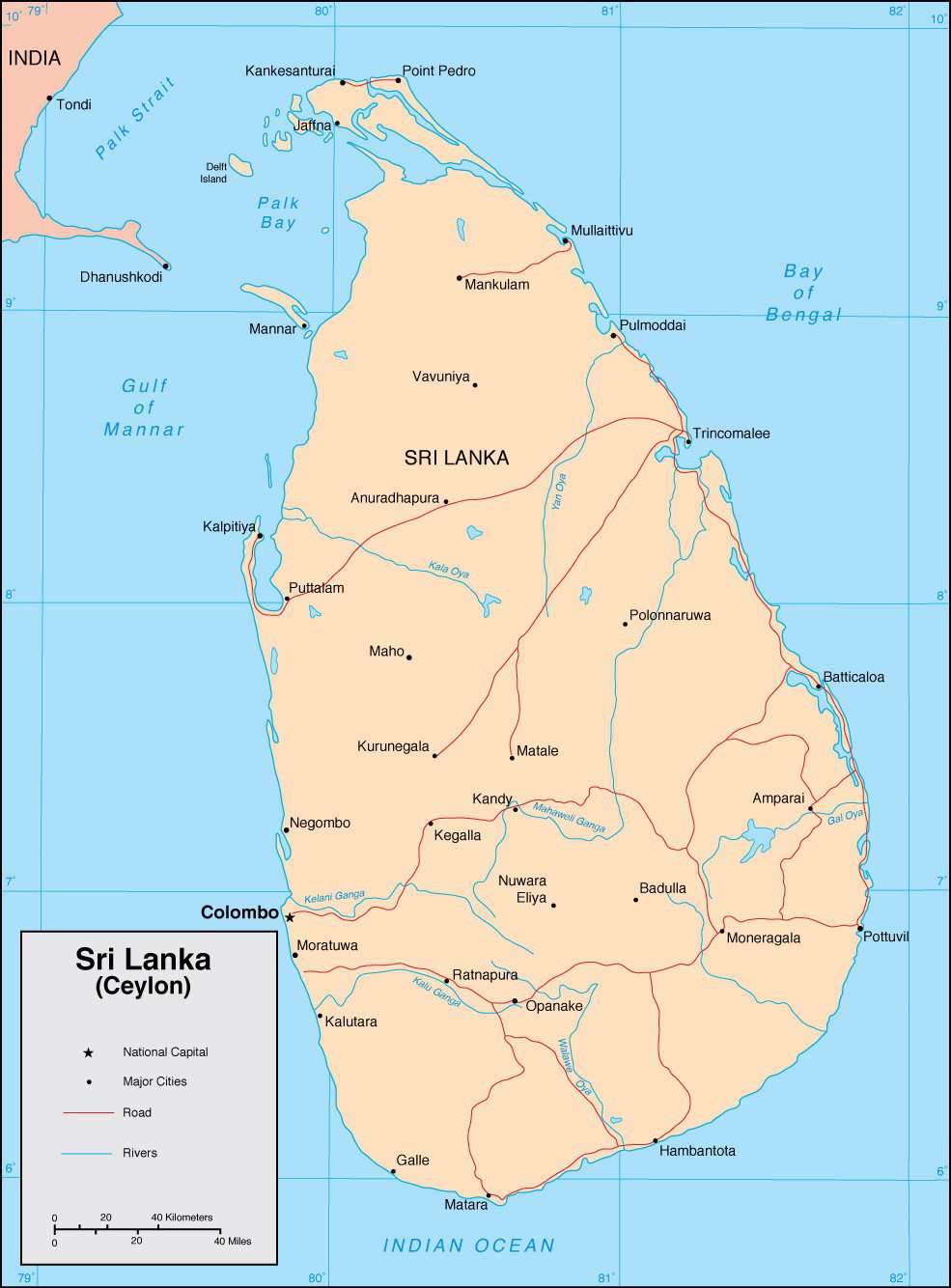
Sri Lanka nerededir?
Sri Lanka is right across the Palk Strait off the southeastern coast of the state of Tamil Nadu in India.
¿Qué es un genocidio?
Raphael Lemkin, the person who coined the term genocide, defined it as “the destruction of nation of an ethnic group.” Article II of the Genocide Convention states:
Genocide means any of the following acts committed with intent to destroy, in whole or in part, a national, ethnical, racial or religious group, as such:
(a) Killing members of the group;
(b) Causing serious bodily or mental harm to members of the group;
(c) Deliberately inflicting on the group conditions of life calculated to bring about its physical destruction in whole or in part;
(d) Imposing measures intended to prevent births within the group;
(e) Forcibly transferring children of the group to another group.
Sri Lanka is guilty of engaging in at least 4 out of these 5 atrocities against the Tamils.
Tamiller kimlerdir?
The Tamils are an ethnic group native to the state of Tamil Nadu in India, as well as the northeastern coasts of the island of Sri Lanka/Ceylon.
The Eelam Tamils are the Tamils native to the northeastern coasts of the island of Ceylon/Sri Lanka/Eelam and have been on the island for millennia.
The Malaiyaha Tamils are the descendants of Indian Tamils brought to Ceylon in the 20th century to work the tea plantation.
The Tamils are speakers of the Dravidian language with the longest literary history, dating back to at least 500 B.C.E. The Tamils are majority Shaivite Hindus, although there is a sizeable minority of Christians within the Eelam Tamil community.
Sinhalalar kimlerdir?
The Sinhala, or Sinhalese are an ethnic group native to the southwestern portions of the island of Ceylon/Sri Lanka.
The Sinhala are primarily follow Theravada Buddhism, although there is a sizeable Christian minority as well.
The Sinhala language is an Indo-Aryan language.
Seylan müslümanlar kimlerdir?
The Sri Lankan Muslims are a federation of many different Muslim-majority ethnic groups, the largest being the Sri Lankan or Ceylonese Moors.
The Moors are an ethnic group that primarily speak Tamil as a home language, however many Muslims are bilingual in both Sinhala and Tamil. In the southwestern Sinhala dominated portions of the island, there has been a shift towards the adoption of Sinhala as a home language for some Muslim families.
Moors in general do not identify with the Moor label and prefer the term Muslims, and as such when we refer to Sri Lanka’s Muslims, we specifically mean the primarily Tamil and sometime Sinhala speaking Muslim population.
Tamil Eelam Kurtuluş Kaplanları (TEKK) kimlerdir?
Tamil Eelam Kurtuluş Kaplanları, diğer adıyla TEKK veya Tamil Kaplanları, 1976’dan 2009’a kadar varlığını sürdüren, lideri Velupillai Prabhakaran ve ailesinin Sri Lanka Silahlı Kuvvetleri tarafından idam edilmesiyle sona eren Tamil milliyetçisi militan bir örgüttü.
Tamil militanlığı, genel olarak, Sri Lanka hükümetinin Tamilce konuşan nüfusa karşı uyguladığı onlarca yıllık ayrımcı politikalara bir tepki olarak başlamıştır.
Velupillai Prabhakaran kimdi?
Velupillai Prabhakaran, Tamil milliyetçisi bir militan ve Tamil Eelam Kurtuluş Kaplanları’nın (LTTE veya Tamil Kaplanları olarak da bilinir) lideriydi. Tamil topluluğunda birçok takma ad veya savaş adı kullanmıştır, bunlardan bazıları şunlardır:
- Thalaivar/தலைவர் («lider» anlamına gelir)
- Thesiya Thalaivar/தேசியத் தலைவர் («ulusun lideri» anlamına gelir)
- Karikaalan/கரிகாலன் (antik Chola imparatorluğunun bir kralının adı)
- Methagu/மேதகு («Ekselansları» anlamına gelir.)
Términos de geografía
¿Qué es el Vánni?
The Vanni refers to the mainland portions of the Northern province of Eelam, comprising the districts of Vavuniya, Mullaitivu, Mannar, and most of Kilinochchi.
The No-Fire Zones that the Sri Lankan government set up in 2009 were located around the towns of Puthukudiyiruppu and Mullivaikkaal in Mullaitivu district, which is in the Vanni.
¿Qué es Mullivaikkaal?
Mullivaikkaal is a town on the coasts of Mullaitivu district in the Northern Province of Eelam, geographically located in the Vanni region. This town was the site of the second and third No-Fire Zones, wherein safe zones were set up surrounding makeshift hospitals built around schools in Mullivaikkaal town.
In the final No-Fire Zone, over 300,000 Tamils were trapped by the Sri Lankan government as they bombarded the makeshift hospitals with heavy artillery and allegedly chemical weapons.
Other terminology questions
What is a No-Fire Zone?
As the Sri Lankan government closed in on the LTTE, beginning in January 2009, the Sri Lankan government designated certain areas in Mullaitivu district as No-Fire Zones, meaning that neither the Sri Lankan government nor the LTTE were to use firearms or heavy weaponry in those zones. The purpose of these No-Fire Zones on paper was to be a safe haven for civilians.
However, what seemed to really be the case was that the Sri Lankan government used these No-Fire Zones as a pretense to herd Tamil civilians into safe zones containing makeshift hospitals which were simultaneously being denied aid by the Sri Lankan government.
What is to be done?
What is the political solution?
The solution to this is a two polities on the island: Eelam and Sri Lanka. Eelam comprises the northeastern parts of the island as originally claimed by proto-state of Tamil Eelam during LTTE control.
Why not a federal state?
- Modifying the Sri Lankan state into a federal state without smashing the settler colonial apparatus will only serve to provide cover for the settler colonialism still happening against the Tamils and Muslims of Eelam.
- Even in a federal apparatus, it’s relatively easy to erode the rights of a minority ethnic group, even if they are given constitutional protections.
- The majority of the island is already against the idea of a federal state anyways to begin with.
In order to fully decolonize Eelam, the first step is to sever the land from the settler colonial apparatus through the severing the state.
What can I do?
The easiest way to boycott Sri Lanka is to simply not ever go there, and tell others not to go there either. Much of Sri Lanka’s continued occupation of Eelam relies on tourism to mask the ongoing war against the Tamil people that the Sinhala Buddhist state is engaging in.
The very reason that you’ve probably only heard of Sri Lanka before stumbling upon this project is that you’ve probably stumbled upon it as a tourist destination.